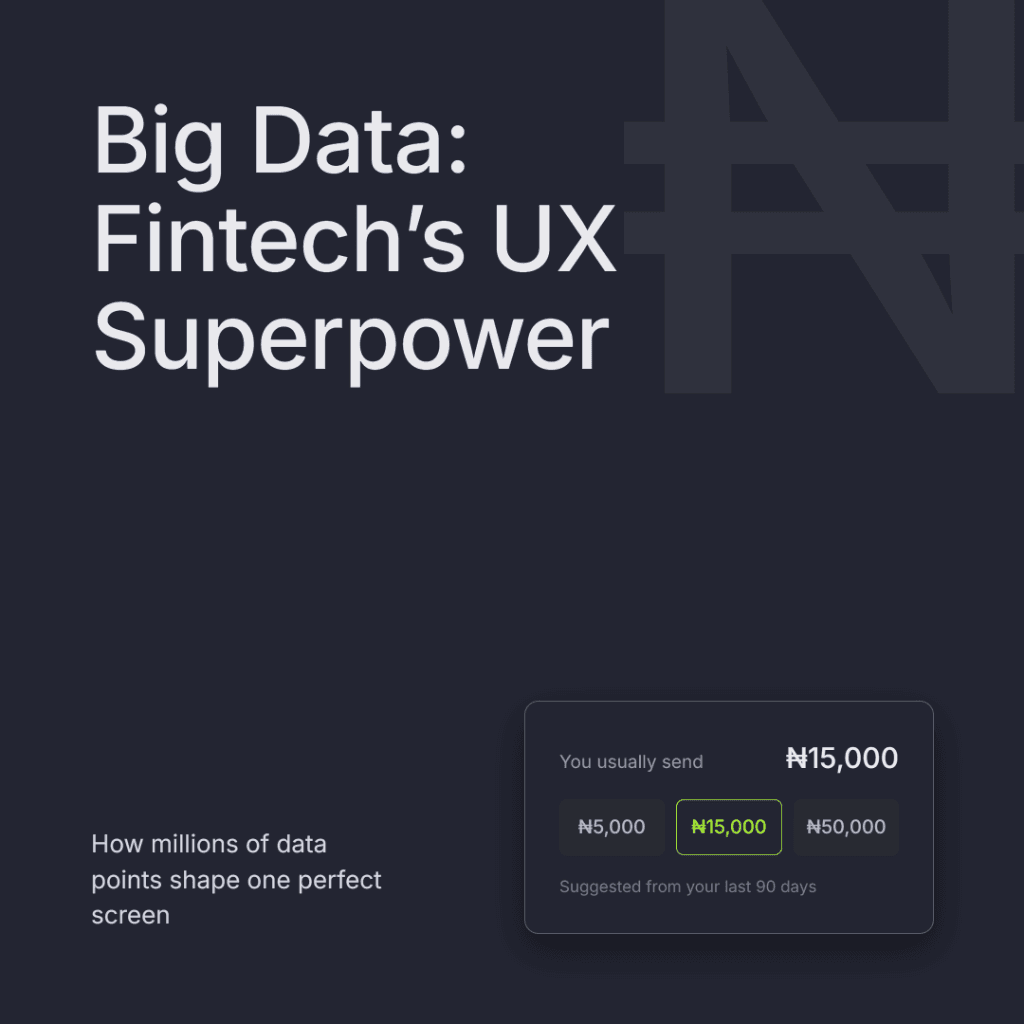
Modern fintech has moved beyond storing customer information. The next competitive advantage is understanding customers deeply enough to deliver experiences that feel intentionally designed for each individual. This is where Big Data becomes one of the most powerful UX tools available.
Rather than viewing Big Data as an infrastructure or analytics problem, fintech companies should see it as the engine that powers every personalized experience a customer encounters.
What is Big Data?
Big Data refers to extremely large and diverse datasets collected from numerous customer interactions, including: transaction history, spending behavior, device information, login frequency, merchant preferences, savings patterns, investment activities, payment habits, location data (where consented), customer support interactions, and credit behavior.
Individually, these datasets tell small stories. Together, they create a living financial profile capable of predicting customer needs before the customer even expresses them.
Recent research shows that Big Data enables fintech companies to identify customer patterns in real time, improve decision making, create personalized products, strengthen fraud detection, and significantly enhance customer experience. (Mhlanga D (2024) The role of big data in financial technology toward financial inclusion. Front. Big Data 7:1184444. doi: 10.3389/fdata.2024.1184444)
The shift from generic banking to personalized experiences
Traditional banking operates around products. Modern fintech should operate around people.
Instead of asking: “What products do we have?” Successful fintech companies ask: “What does this customer need right now?” Big Data provides the answer.
1. Personalized Dashboards
Most fintech dashboards look identical. Everyone sees balance, Recent Transactions, Transfer Button, Bills, and Cards. Big Data allows dashboards to adapt. For example:
- Customer A:Shows spending analysis first, budget reminders, daily expense insights.
- Customer B:Investment portfolio, stock watchlist, wealth growth metrics.
- Customer C:Loan repayment progress, upcoming installments, credit score improvements.
The interface changes because customer priorities change. That's better UX.
2. Intelligent Financial Recommendations
Netflix recommends movies, Spotify recommends music. Why shouldn't fintech recommend better financial decisions? Using behavioral analytics, fintech companies can identify recurring subscriptions, excessive spending, savings opportunities, unusual expenses, investment readiness, and loan eligibility.
Instead of displaying generic tips, the app can say: “You spent ₦48,000 on food delivery this month. Saving just 15% of that could add ₦86,000 to your savings this year.”
3. Smarter Loan Offers
Nothing frustrates customers more than irrelevant financial offers. Big Data enables fintech companies to evaluate income stability, cash flow, repayment behavior, transaction consistency, employment patterns, and financial discipline.
Instead of showing every customer: “Borrow up to ₦500,000” The platform might say: “Based on your recent cash flow, you're prequalified for a business expansion loan with lower interest.”
Academic research highlights that Big Data enables fintechs to assess customer risk more accurately and tailor loan conditions and interest rates to individual profiles rather than relying on broad customer categories.
4. Adaptive Onboarding
Most fintech onboarding experiences are identical. Big Data allows onboarding to evolve. If user behavior suggests someone primarily performs transfers, the application can prioritize transfer shortcuts, recipient management, payment history, and transaction tracking.
A different customer focused on investing could immediately receive educational content, portfolio tracking, and market insights.
5. Dynamic User Journeys
Every customer follows different financial habits. Big Data allows fintechs to create adaptive experiences where navigation changes based on behavior. Examples include frequently used actions becoming more accessible, rarely used features moving into secondary menus, shortcuts evolving over time, and recommendations improving with continued usage. The application gradually learns alongside the customer.
Personalization Must Never Compromise Trust
While Big Data creates remarkable experiences, it also introduces significant responsibilities. Personalization succeeds only when customers trust that their data is collected responsibly, protected securely, and used with clear consent. Privacy is not the opposite of personalization; it is what makes personalization sustainable.
Final Thoughts
Big Data is often discussed as a technology initiative, but its greatest impact is ultimately human. Every transaction, login, bill payment, savings deposit, and financial decision tells a story about the person behind the screen. The fintech companies that transform those signals into meaningful, respectful, and timely experiences will build products that customers don't just use; they trust and return to.
The future of fintech UX isn't about adding more features. It's about creating products that feel like they understand each customer without becoming intrusive. Big Data, when paired with thoughtful UX design and strong privacy practices, enables fintechs to move from one size fits all banking to truly personalized financial experiences.
In the end, the most successful fintech apps won't be the ones with the most data. They'll be the ones that use data to make every interaction feel relevant, effortless, and genuinely helpful.